
Online school · home education · qualifications
Could online schooling work for your family abroad?
Online learning can preserve a familiar curriculum, make a mobile year possible or help a child who does not suit the local school options. But the word ‘online’ covers very different arrangements. This guide helps you check what you are actually buying—and whether it will still work after the move.
Last verified 10 September 2026
The short answer
It can work—but choose the education route before the provider
A strong arrangement has four parts: a lawful education position in the place the child lives, a credible provider, a qualification and exam route the next institution will accept, and a weekly routine that protects learning, sleep, support and friendships. If any one of those is vague, the glossy lesson platform is not enough.
First, name what you are comparing
Six different services can look like “online school”
The label tells you very little about who is responsible for teaching, attendance, records or qualifications.
Live online school
A school timetable taught by teachers in real time. This can provide structure and classmates, but the teaching time zone must work in Southeast Asia.
Flexible online school
Recorded or self-paced lessons supported by teachers. It is easier to schedule, but families should check feedback, contact time and who notices when a child struggles.
Curriculum or course provider
Lessons and materials for a parent to organise. Buying a curriculum is not the same as enrolling in a recognised school or securing a qualification.
Qualification subjects
Individual IGCSE, A level, AP or IB courses can fill a gap. Confirm who enters the child for exams and who issues the complete school record or diploma.
Home education
The family takes legal and practical responsibility under the rules that apply to the child. An online provider may be one resource within that arrangement.
Hybrid centre or learning group
Children learn online and meet locally for support or activities. Check the centre, supervision and local permissions separately from the online school.
Be honest about the family week
When online schooling may—and may not—fit
It may be worth exploring when…
- a child needs curriculum continuity during a defined move;
- local schools cannot provide a required subject or appropriate support;
- the family can provide a calm workspace, reliable supervision and backup internet;
- the timetable leaves room for sleep, movement and regular local friendships; and
- the return, transfer or qualification route has been checked with the future receiver.
Pause when…
- the provider cannot explain whether it is a school, course company or tutor;
- “international accreditation” cannot be matched to an official record;
- live lessons happen late at night in the destination;
- no adult has time for the supervision the child actually needs; or
- local education, immigration or exam arrangements are being left until after arrival.
Check the provider's claims at source
A five-part check before you pay
Keep the evidence and the date. Provider status, subject availability and assessment arrangements can change.
- 1
Identity
Find the legal entity, trading name, address, responsible education authority and complaints route. Match the exact online provision—not a similarly named physical school.
- 2
Status
Open the issuing body's directory yourself. Record whether the claim covers a school, programme, qualification, exam centre, inspection or membership, and when it expires.
- 3
Teaching and care
Check teacher contact, class size, feedback, attendance, progress reports, learning support, safeguarding lead, staff checks and what happens when a child disappears from lessons.
- 4
Records and qualifications
Ask who issues transcripts, credits, predicted grades, references and the final award. Then ask the likely next school, university or authority whether it accepts them.
- 5
Contract and exit
Price the complete year and read trials, cooling-off rights, notice, refunds, missed lessons, data use, closure and record release before committing.
Where to find current options
Start with an official register, not a “best online schools” list
These routes help you verify a claim. Inclusion is not a SettleHappy recommendation, and each family still needs to check fit and recognition.
| Education route | Useful official starting point | What it does not prove |
|---|---|---|
| England-accredited online school | Get Information about Schools can show current online-provider and accreditation details under the DfE scheme. | That the timetable, support, exams or resulting transfer will suit a child overseas. |
| Cambridge pathway | Use Cambridge International's information for parents and approved-school search. | That every claimed subject is offered, or that the destination or future institution accepts distance learning. |
| IB Diploma Programme | The IB explains individual online DP courses and its full online DP pilot. | That any online tutor can deliver an IB course or award the IB Diploma. |
| Pearson Edexcel qualifications | Check the exact qualification and ask Pearson or the provider to identify the approved exam-entry route. | That lessons and every assessment can be completed remotely from home. |
| US high-school diploma | Check school accreditation through the responsible US state education agency and the named accreditor. | Federal approval: the US Department of Education does not accredit K–12 schools. |
The child lives somewhere, even when the school is online
What to confirm in each Southeast Asian destination
This is a research map, not a declaration that one route is approved for every family. Nationality, age, residence status and the exact arrangement can change the answer.
🇹🇭Thailand
What the official framework shows: Thai education law recognises family-provided basic education, with an approval process involving the education authority.
Ask before the move: Ask the relevant Thai education authority how the arrangement applies to your child and which plan, registration, assessment and reporting steps are required.
🇲🇾Malaysia
What the official framework shows: Malaysia's Ministry of Education describes home schooling through an exemption from compulsory primary education rather than as an automatic alternative.
Ask before the move: Confirm eligibility and the current application process with KPM. Do not assume enrolment with a foreign online provider creates the required exemption.
🇻🇳Vietnam
What the official framework shows: We found no clear Ministry of Education and Training page that turns overseas online-school enrolment into a general local schooling route.
Ask before the move: Obtain written guidance for the child's nationality, residence status, age and intended qualification, including how records or awards would be recognised later.
🇮🇩Indonesia (including Bali)
What the official framework shows: Indonesia has recognised sekolahrumah pathways; national assessment information refers to eligible home-school learners registered in the education data system or holding a valid NISN.
Ask before the move: Confirm the current registration, supervising institution, assessment and certificate route with the local education office before relying on an overseas programme.
🇵🇭The Philippines
What the official framework shows: DepEd's Homeschooling Program is an Alternative Delivery Mode offered through authorised public or private schools under its updated guidelines.
Ask before the move: Verify the partner school's current authority and ask how enrolment, assessment, learner records, promotion and completion will work for your child.
Keep education and immigration as two separate checks. A child may be able to access lessons online without the provider being able to sponsor a student visa or satisfy a local education requirement. Get both answers in writing from the responsible authorities.
Start with the final assessment and work backwards
Exams can turn an online course into a physical journey
Choose the award
Exact qualification, syllabus, subjects and assessment components.
Find the entry route
Approved centre, private-candidate policy and registration deadline.
Check every component
Written, oral, practical, coursework and access arrangements.
Price the real journey
Entry fees, centre charges, travel, accommodation and a backup plan.
Make a timetable in the destination's clock
“Live lessons” can mean afternoons—or the middle of the night
Your selected-currency example
Compared with London, Thailand and Vietnam are 6–7 hours ahead; Malaysia, the Philippines and Bali are 7–8 hours ahead.
Current differences use London as the GBP example. Other locations and daylight-saving dates vary.UTC+7Thailand and Vietnam
UTC+8Malaysia, the Philippines and Bali
Test two weeks, not one sample class
- Convert every lesson, tutorial and club across daylight-saving changes in the provider's country.
- Add homework, meal times, exercise, sibling schedules and the working adult's availability.
- Ask whether recordings are a genuine alternative and when a teacher will answer questions.
- Protect a consistent sleep window; a prestigious timetable is not a good fit if the child is exhausted.
The subscription is only one line
Build the complete annual cost
school year
Also model foreign-exchange movement, tax, deposits, sibling pricing, annual rises, travel to exams and the cost of changing route if the arrangement does not work.
Design a life, not only a lesson plan
Give the child a dependable local week
Learning contact
Regular teacher feedback, small-group discussion and a named person who monitors progress.
Movement
Outdoor time or sport scheduled before screen fatigue and tropical heat make it easy to skip.
Repeated friendships
The same children each week through a safe club, activity, faith group or community—not only one-off trips.
Local connection
Age-appropriate contact with the place, language and community the family has moved into.
Plan two ways to get online. Compare fixed broadband, mobile data, router setup, power resilience and streaming access in our phones, internet and streaming guide.
Downloadable quick reference
Compare online-school options without losing the important questions
Use the checklist online while researching, then download the printable version for provider calls and your family move folder.
Research from home
Online-schooling comparison checklist
Use this from home to compare the education route, provider, recognition, exams, timetable, support and complete family week before enrolling or moving.
How to use it: read the section above first, then tick an item when you have captured the answer or evidence in your own move folder. The PDF is the offline quick-reference version.
1Define the education route
2Verify the provider and claims
3Prove the record, qualification and exam route
4Test the family week in destination time
5Price the year and protect the exit
Keep exploring the education plan
Compare online learning with the local alternatives
Bring the research together
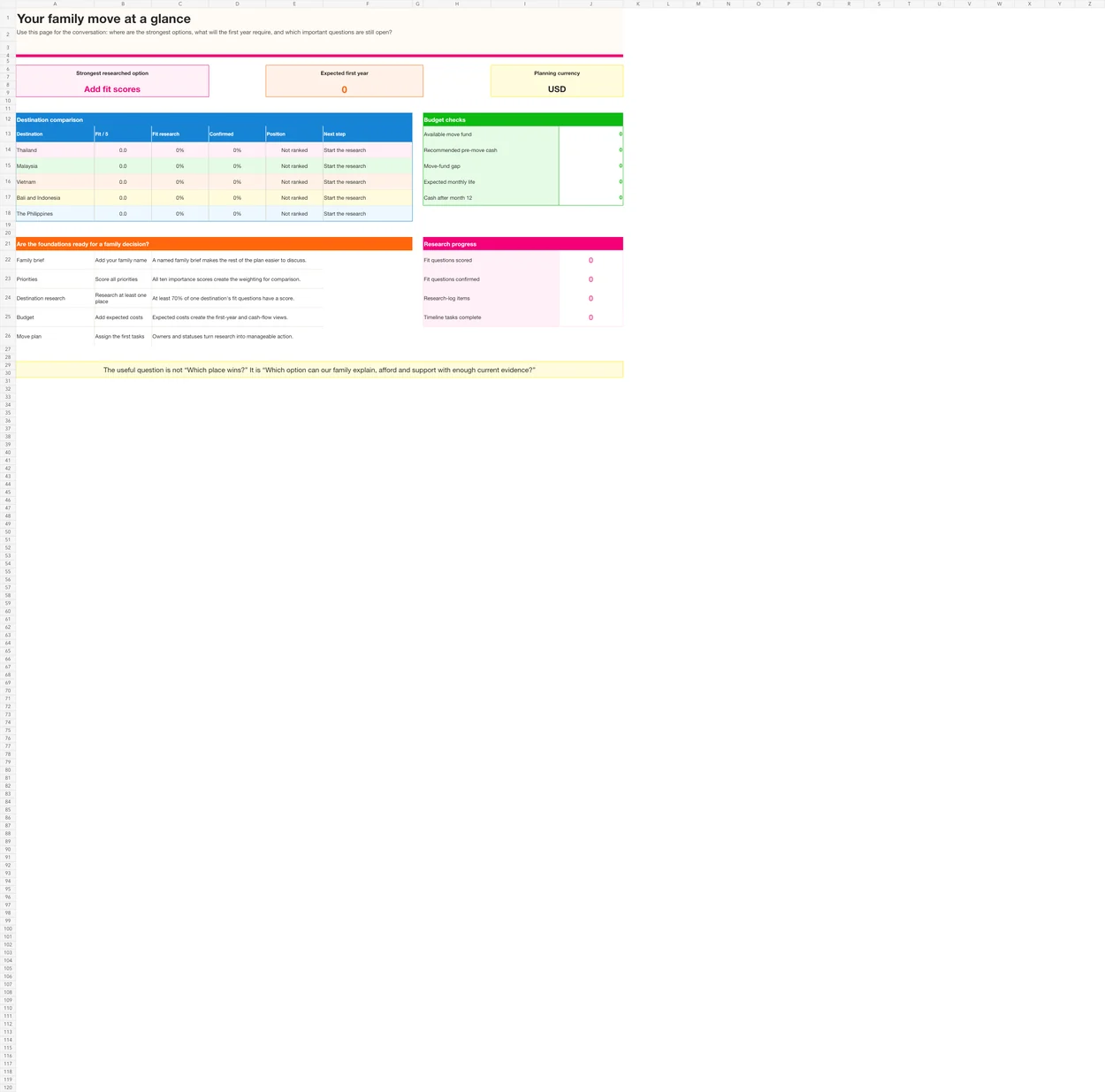
Ready to turn your research into a family move plan?
The Family Move Planner keeps your destination comparison, family priorities, budget, sources, questions and timeline in one organised system.
£39one-time digital purchase
Common questions
Questions families ask about online schooling abroad
Is online schooling the same as homeschooling?
Not necessarily. A full-time online school may employ teachers, set a timetable and issue records, while home education usually leaves more legal and educational responsibility with the family. A curriculum subscription or tutoring service may be neither. Ask who is legally responsible, who teaches and who issues the final record.
Can an expat child attend an online school while living in Southeast Asia?
It may be practically possible, but that does not by itself answer local compulsory-education, residence or immigration requirements. Confirm the position for the child's age, nationality and destination with the responsible local authority before withdrawing from a recognised school or moving.
How do I check whether an online school is accredited?
Ask for the exact legal name, campus or online-provider record, accrediting or approving body, scope and expiry date, then check it in the issuing body's own current directory. Accreditation of a curriculum, exam centre or parent company does not automatically cover the school or every qualification.
Are Cambridge, Pearson or IB online programmes recognised?
These organisations offer or support different online routes, but the exact school, programme, subjects, assessment and exam arrangements matter. Use each organisation's official directory and ask the future school, university or authority whether it accepts the resulting record or qualification.
Can children take all their exams online?
Do not assume so. Some assessments may be online, but many regulated qualifications still require an approved centre, supervised conditions or practical and oral components. Get the exam-entry plan, location, deadlines, access arrangements and complete fees in writing.
Which teaching time zone works best in Southeast Asia?
Thailand and Vietnam use UTC+7; Malaysia, the Philippines and Bali use UTC+8. A European morning timetable may begin in the afternoon locally, while live North American lessons can run late at night. Check the provider's actual timetable across daylight-saving changes, not only its advertised flexibility.
Will online school support a student visa?
Do not plan on it without written confirmation from the destination's immigration authority. A foreign online provider may have no local sponsor status, and a parent's residence route does not automatically settle a child's study position.
How much adult help does online schooling require?
It varies widely. Younger children, children with additional needs and self-paced programmes may require substantial daily supervision. Ask for the real weekly timetable, expected parent role, teacher response times and attendance process, then test it against both adults' work and care responsibilities.
How can an online-schooled child make friends after moving?
Build regular, repeated contact rather than relying on occasional outings: one sport or creative activity, a local language or community group and a small number of familiar families. Check safeguarding and supervision at any learning centre or group just as carefully as you would at a school.
What happens if we return home or change to a physical school?
Ask the receiving school or authority in advance which transcripts, attendance records, assessments, credits and qualifications it will accept. Keep dated samples of work and official records. Recognition should be confirmed by the receiver, not promised only by the provider you are leaving.