
School support · therapy · a careful transition
Moving abroad with a child who has special educational needs
A school place is only the beginning when a child needs additional support. Families need to understand what the new school can actually provide, who will deliver it, what it costs and how learning and therapy will continue during the move.
Last verified 11 September 2026
The short answer
Start with what your family needs to protect
Begin with the child's real day, not a school's inclusion statement. Share a clear learner profile and relevant records, then ask each shortlisted school to confirm in writing how it would meet the child's needs. A plan or diagnosis from home is useful evidence, but its legal status, funding and named provision do not automatically transfer to another country or a private international school.
Keep the decision grounded
Four things to protect throughout the move
Use these priorities when comparing destinations, schools, care and timing. A plan that works on paper still needs to work in an ordinary family week.
A genuinely suitable school place
Confirm teaching, communication, sensory, physical, medical and social support for this child in this year group—not only a general willingness to enrol.
Continuity of care
Map assessments, medication, therapy, equipment and specialist follow-up across the final months at home and the first months abroad.
A complete annual budget
Add learning support, classroom assistance, therapy, transport, assessments, technology and family travel to tuition and registration fees.
A humane transition
Give the child an accessible explanation, familiar people and routines, a gradual school start where possible and a way to communicate when the day feels too much.
A practical sequence
Work through the decision in a calmer order
Each stage produces a useful answer, record or agreement before the family takes the next step.
- 01Before shortlisting
Describe the support that works
Write a one-page learner profile covering strengths, interests, communication, independence, sensory needs, successful adjustments, distress signals and what helps recovery.
- 02Before applying
Send enough evidence for an honest answer
Provide recent reports, support plans, attainment, therapy summaries and relevant medical information. Explain any support that is currently informal or family-funded.
- 03Before accepting
Turn reassurance into named provision
Record the class, teacher expertise, learning-support staffing, timetable, therapy model, adjustments, emergency plan, fees and review dates the school proposes.
- 04After arrival
Review the lived school day
Check attendance, fatigue, belonging, progress, transport and behaviour across settings. A child who is coping at school may still be using all their capacity before getting home.
Look beneath the word support
Build the support around the child
Strong provision is a connected system. One helpful teacher cannot replace missing specialist capacity, accessible facilities or a workable home-to-school day.
Classroom
Teaching adjustments, communication, sensory environment, curriculum access and a plan for less structured parts of the day.
Specialist
Qualified assessment or therapy, clear goals, consent, records and communication with the school and family.
Practical
Accessible buildings, safe transport, equipment, personal care, medication and emergency arrangements.
Belonging
Friendships, clubs, trips, celebrations and age-appropriate participation—not simply a seat in the room.
Turn reassurance into something useful
Write down the answer you can actually rely on
Keep names, dates and documents with the answer. General promises are difficult to use when staff, circumstances or countries change.
| Ask about | A useful answer includes | A vague answer sounds like |
|---|---|---|
| Staff and responsibility | Named qualified lead, class support, cover arrangements and who reviews progress | “Our teachers differentiate for everyone” |
| Therapy | Provider, licence, location, frequency, goals, reports, school coordination and complete cost | “There are therapists nearby” |
| Curriculum and assessment | How work is adapted without closing future qualification routes, plus approved access arrangements | “We can make the work easier” |
| Behaviour and regulation | Preventive support, safe de-escalation, family contact and clear exclusion or attendance policy | “We decide case by case” |
| Future capacity | Support in the next year group, secondary stage and during staff absence or rising need | “We will see how it goes” |
Pause and check
Signs that the plan needs a closer look
One concern does not always end the move, but it should produce a clearer answer before the family commits.
Acceptance before reviewing records
A quick yes may mean the school has not understood the child's needs, staffing or likely adjustments.
A compulsory shadow with no clear role
Ask who employs, trains, supervises and replaces the adult, how independence is built and whether access depends on the family finding staff.
Support fees with no defined service
A supplement should identify hours, staff, assessment, reporting, exclusions and review—not simply carry an additional-needs label.
No plan for difficult days
Ask what happens during overload, absence, dysregulation, medical need, a trip, an exam or a change of teacher.
Research from home
Six useful things to organise before moving
These actions reduce pressure after arrival and make provider conversations more specific.
Create a portable record
Keep diagnoses, assessments, support plans, school reports, attainment, therapy summaries, medication and equipment information in accessible digital and paper form.
Prioritise what cannot pause
Ask current clinicians which treatment, medication, therapy or equipment needs continuous provision and what can safely wait.
Speak to the support lead
Do not rely only on admissions. Meet the person responsible for learning support and, where possible, the likely class or pastoral lead.
Price the complete school day
Include support fees, transport time, therapy travel, adult availability, assistive technology and the cost of a backup route.
Check examination arrangements early
For older pupils, identify evidence deadlines, approved arrangements, exam-centre responsibility and whether prior accommodations can continue.
Keep a second option alive
Know which alternative school, online provision or return route could protect learning if the first placement cannot deliver what was agreed.
What changes by destination
Confirm the local system before relying on the plan
Regional guidance can organise the questions. Only the responsible authority, institution or appropriately qualified professional can confirm how the current local rules apply.
Education rules
Confirm compulsory-education, home-education and disability rules for the child's nationality, age and residence status. International-school practice may differ from the public system.
Professional licensing
Verify psychologists, therapists and medical professionals through the destination's regulator. The same job title can represent different training or scope.
Insurance and payment
Check assessments, developmental care, therapy, mental health, medication, equipment and pre-existing-condition terms separately; school support is often outside health cover.
Language and records
Ask which documents need translation, whether assessment tools suit the child's language and culture and who can communicate with home-country professionals.
Save these questions
Questions to answer before the move becomes fixed
Use the people and institutions named in each question. “It should be fine” is not a complete answer for a high-value family decision.
- 01
Who has reviewed my child's records and met the child or current team?
- 02
What support would happen in an ordinary lesson, break, trip and difficult day?
- 03
Which staff are qualified to deliver it and what happens when they are absent?
- 04
What is included in tuition and what attracts an additional fee?
- 05
How are goals, progress and the child's experience reviewed with the family?
- 06
Can the school support the next year group and intended qualification route?
- 07
Which therapies or clinical services must be arranged outside school?
- 08
What happens if the school later decides it cannot meet need?
Bring the research together
Ready to turn your research into a family move plan?
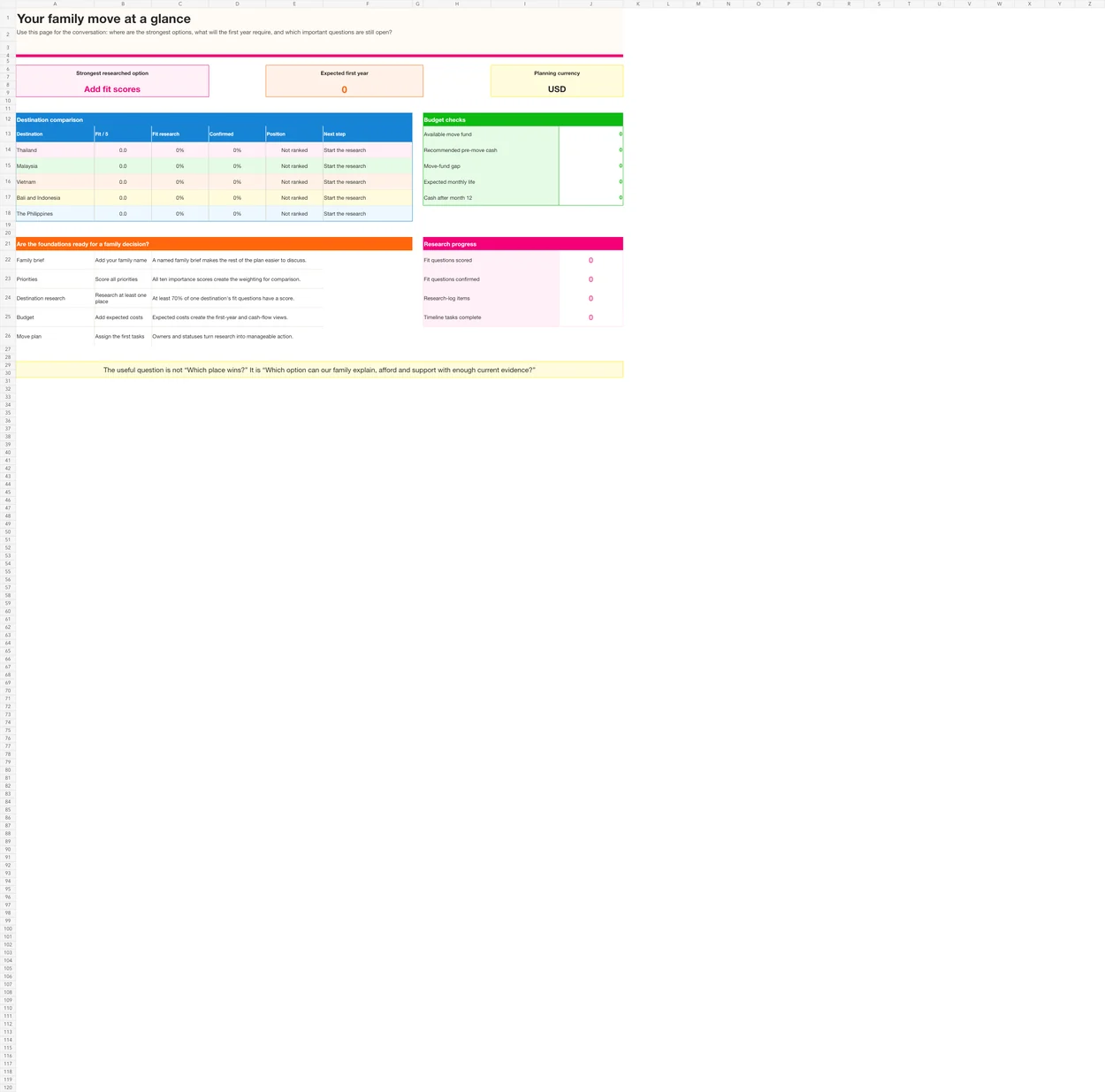
The Family Move Planner keeps your destination comparison, family priorities, budget, sources, questions and timeline in one organised system.
£39one-time digital purchase
Common questions
Questions families ask about moving abroad with a child who has special educational needs
Will my child's EHCP, IEP or 504 Plan transfer abroad?
It remains valuable evidence of need and successful support, but the legal duties, funding and named provision usually belong to the system that issued it. Ask the destination authority and school what status it has and obtain the new provision in writing.
Do international schools have to accept children with special educational needs?
The answer depends on local law, the school and the child's needs. Private international schools may set admissions criteria and support limits even where the country has wider inclusion commitments. Ask the responsible authority and school rather than assuming home-country rights apply.
Should we disclose a diagnosis during admission?
Give the school enough accurate information to assess safety and provision honestly. Read the application and privacy terms, explain strengths and support as well as diagnosis, and ask how information is used. Withholding material needs can undermine planning and the placement.
What is a school shadow or learning-support assistant?
The terms can describe an adult supporting one child in class, sometimes funded or employed by the family. Ask about qualifications, employer, safeguarding checks, supervision, cover, goals, confidentiality and how independence will grow.
How do we compare therapy abroad?
Verify the practitioner's local licence, training, language, approach, assessment, goals, frequency, records, safeguarding and communication with school and family. Check whether the provider can treat children and the specific need.
Can my child receive exam access arrangements abroad?
Possibly, but arrangements follow the awarding body's current rules and evidence deadlines. Prior adjustments do not automatically guarantee the same provision. Ask the school's examinations officer well before entries are made.
What should be in a learner profile?
Keep it short and practical: strengths, interests, communication, learning, sensory and physical needs, successful adjustments, distress signs, recovery supports, independence, medical essentials and the child's own preferences.
What if no school can meet our child's needs?
Pause the move or location decision if necessary. Explore other cities, a carefully verified online or home-education route, additional family-funded provision or remaining where established support is secure. The destination should fit the child, not the reverse.