
Immigration routes · dependants · work
Family visas for moving to Southeast Asia
A visa can be valid for years and still be wrong for the family activity you have planned. Start with what every adult and child will actually do, then match each person to the current official route.
Last verified 31 August 2026
The short answer
Which country has the best family visa?
For a shorter remote-working stay, Malaysia's DE Rantau or Thailand's DTV may be worth exploring. A sponsored job may provide a more suitable basis for a longer move. Families with the required funds may consider MM2H or another capital-based option. The right choice still depends on the spouse's work, each child's study status, renewal rules and possible tax obligations.
Four separate questions for every family member
A visa does not answer every legal question
Possible visa options in five countries
Where to start and what to check carefully
This comparison helps you identify options to research; it does not decide eligibility. Open the country guide for more detail and official sources.
Thailand
Possible starting points
DTV, education, employment or high-threshold LTR
What it means for a family
DTV can include eligible spouse/children, but official guidance directs a child studying as their main purpose to Non-ED status.
DTV is a special tourist visa and not permission for Thai employment.
Malaysia
Possible starting points
MM2H, DE Rantau or Employment Pass
What it means for a family
MM2H has category-specific dependant rules; DE Rantau can include eligible dependants for a maximum published total of 24 months.
MM2H national categories involve fixed deposits and compulsory property; a DE Rantau dependant spouse cannot work.
Vietnam
Possible starting points
Work, investment or eligible family sponsorship
What it means for a family
A stable family move normally relies on a qualifying sponsor and linked residence documentation.
The official e-visa is up to 90 days and does not create work permission or a durable school-year plan.
Indonesia (Bali)
Possible starting points
Current E30/E31/E33 or other qualifying residence category
What it means for a family
The official index lists student, spouse, child and remote-worker categories with separate codes.
Old B211A-era labels can be misleading. Verify the live code and permitted activity in the official portal.
Philippines
Possible starting points
SRRV, marriage, employment/investor or visitor extensions
What it means for a family
SRRV Classic can include spouse and unmarried children under 21 when the principal qualifies.
The SRRV principal must be 40+; visitor extensions do not create work rights or guaranteed settlement.
Plan for each family member
Write down the position for every person
If any answer is still an assumption, wait before making a non-refundable payment that depends on it.
| Person | Main activity | Visa and sponsor | Permission confirmed | Expiry / renewal point |
|---|---|---|---|---|
| Adult 1 | Remote, local work, business or non-working | Exact current code | Activity in writing | Date + continuing criteria |
| Adult 2 | Own activity—not “spouse” | Principal or dependant basis | Especially work permission | Effect if principal changes |
| Child 1 | School / dependant | Student or family status | Study permitted | School/sponsor dependency |
| Child 2 | School / dependant | Own application record | Study permitted | Age or relationship limit |
Remote work raises three separate questions
Working online still takes place in a country
Immigration
Does the route permit this remote activity, client/employer and location?
Personal tax
Could days, residence, remittance or locally performed services create filing/tax?
Employer/business
Could payroll, labour law, social security or corporate presence affect the overseas organisation?
One approval is not the other two. A remote-worker visa does not promise that income is outside local tax or that an overseas employer has no local obligations.
Before choosing a visa agent
Seven answers to get before transferring money
- The exact current official category code and issuing-authority link.
- Who legally sponsors each family member.
- Which work, study and business activities are permitted.
- Government fees separated from professional and third-party charges.
- Documents, legalisation, translation and realistic sequence.
- Extension, reporting, re-entry and cancellation conditions.
- Refund position if the application is refused or the category changes.
Country visa guides
Compare the main options for each country
If either adult plans to work
Read the country work-permit guide as well
Local employment, overseas remote work, business activity and professional practice do not share one permission.
Two checks for the whole family
Research remote work and dependant rights separately
Bring the research together
Ready to turn your research into a family move plan?
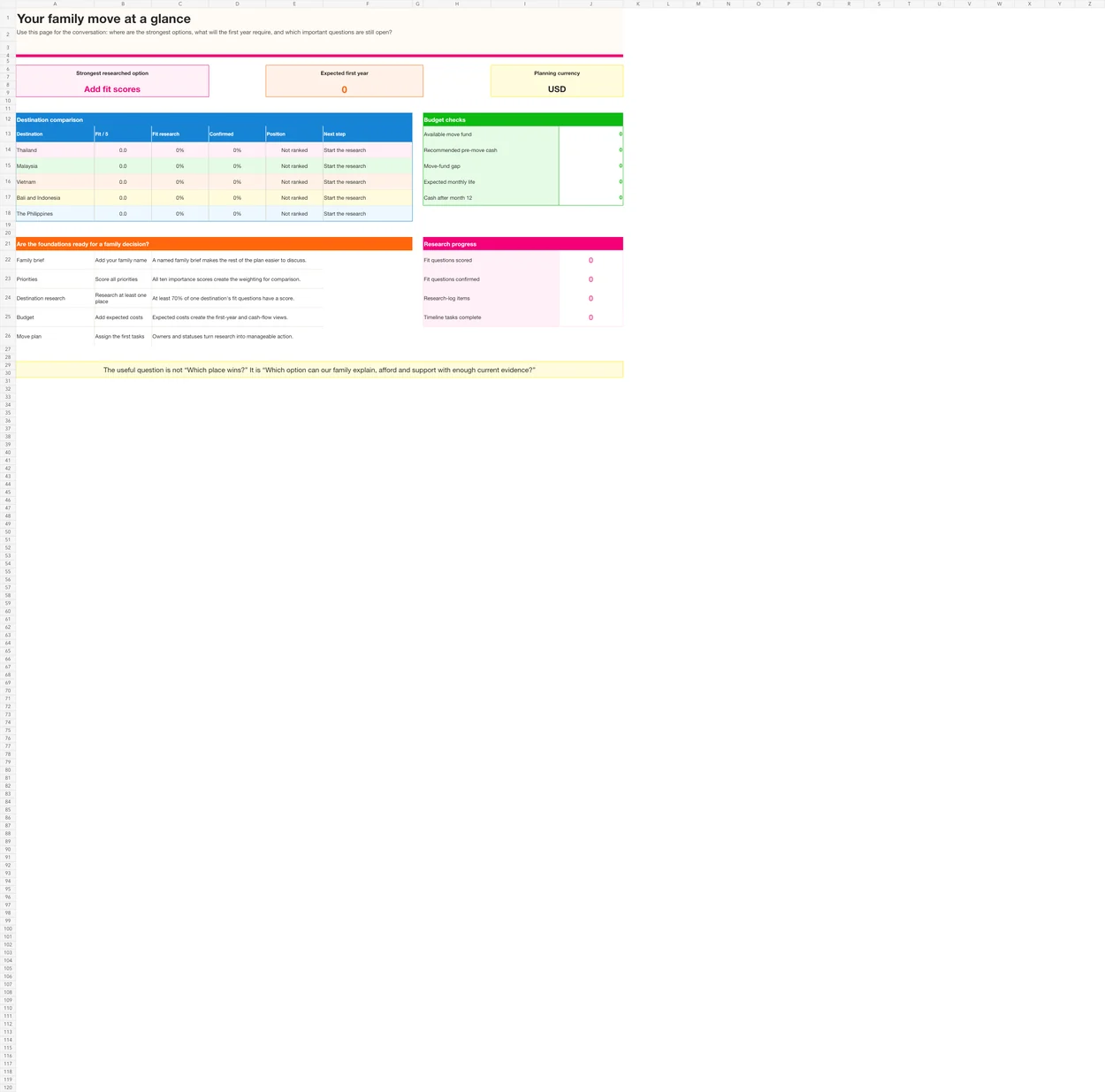
The Family Move Planner keeps your destination comparison, family priorities, budget, sources, questions and timeline in one organised system.
£39one-time digital purchase
Common questions
Questions about family visas
What is the easiest family visa in Southeast Asia?
There is no universal easiest route. Malaysia's DE Rantau can suit an eligible remote professional for up to 24 months; Thailand's DTV may fit an eligible remote adult but not replace a child's education status; the Philippines' SRRV starts at age 40. Eligibility and intended activity determine ease.
Does one parent's visa automatically cover the whole family?
No. Some principal routes permit dependant applications, but each family member still needs the correct status and documents. A child's school status may not cover both parents, and a dependant spouse may not have work permission.
Can my spouse work on a dependant visa?
Do not assume so. Malaysia's DE Rantau FAQ expressly says a dependant spouse cannot work, and other countries separate family residence from employment authorisation. The spouse should identify their own permitted activity before the move.
Can a child attend international school on a remote-worker visa?
Country rules differ. Thailand's official DTV guidance says a child whose primary purpose is study should use the Non-Immigrant ED route. Elsewhere, confirm the child's study or dependant basis with the school and immigration authority rather than extrapolating from the parent's status.
Is a digital-nomad visa the same as tax residence?
No. A visa answers immigration questions; tax residence and income source use separate laws. A person can acquire tax obligations before a visa expires, and work performed locally may raise employer or source issues.
Should we use a visa agent?
Professional help can be useful, especially where sponsorship, legalisation or changing category codes are involved. Verify that the adviser is properly authorised, insist on the current official code and government source, and separate government fees from professional fees in writing.
Can we use repeated tourist visas as a residence plan?
Visitor status can support scouting or a reversible stay, but it is not a dependable substitute for residence or work permission. Entry remains subject to the rules and border decision, while school, banking, tax and employment may need a more durable basis.
How early should we start the visa process?
Start route research before paying non-refundable school or housing charges. Timings vary by category and documents may require passports, birth/marriage records, police or health certificates, legalisation, sponsor paperwork, bank evidence and insurance.
Does a long-stay visa lead to permanent residence?
Not automatically. Malaysia's MM2H FAQ explicitly says the programme does not lead to permanent residence or citizenship. Other long-validity programmes also have their own renewal, cancellation and permanent-residence rules.