
Five countries · one honest comparison
Moving to Southeast Asia with a family
Thailand, Malaysia, Vietnam, Bali and the Philippines can all offer children a brilliant experience. The challenge is finding the country where your visa, school, healthcare, work and budget all fit together.
Last verified 26 August 2026
START HERE
There is no single winner—the right choice depends on your family
Malaysia is our strongest all-rounder. Thailand has the widest established choice of family services. Vietnam can offer exceptional daily value when long-term status is secure. Bali stands out for community and lifestyle. The Philippines makes English easiest, but schools, healthcare and transport vary greatly by location.
Like-for-like planning data
The five-country family comparison
Monthly ranges include international school for a family of four. They are directional planning bands, last researched August 2026—not guarantees or minimum-income requirements.
| Country | Family grade | Monthly range | School range | International connections | Central trade-off |
|---|---|---|---|---|---|
| 🇹🇭 Thailand | A− | £2,000–£4,600/mo | about £6,000–£13,000/yr | Bangkok is a major regional hub; compare the complete route from your home airport | No single long-stay visa fits every remote-working family; status must match work and study |
| 🇲🇾 Malaysia | A | £2,000–£4,700/mo | about £3,800–£20,000/yr | Kuala Lumpur is a major regional hub; Penang and Johor routes may require another leg | MM2H involves substantial fixed deposits and compulsory property purchase; DE Rantau is time-limited |
| 🇻🇳 Vietnam | B+ | £2,000–£4,700/mo | about £8,700–£31,000/yr | Hanoi and Ho Chi Minh City are the main international gateways; Da Nang often adds a connection | A 90-day e-visa is not a long-term family residence or work solution |
| 🇮🇩 Indonesia (Bali) | B+ | £3,100–£5,500/mo | about £9,500–£14,000/yr | Bali is well connected within Asia and Australia; many long-haul journeys require a connection | Traffic, wet-season disruption, specialist healthcare and exact visa/work permissions |
| 🇵🇭 The Philippines | B | £1,600–£4,000/mo | about £2,800–£22,000/yr | Manila is the main long-haul gateway; Cebu and smaller islands can add a domestic leg | School/healthcare quality and transport reliability vary sharply by location |
Choose by the thing you cannot compromise
A shortlist by family priority
Strong English, healthcare and international schools; the visa capital or time horizon is the main test.
02Widest choice of schools and healthcareThailandThe broadest mix of schools, hospitals and established international communities; immigration status needs careful matching.
03Strongest day-to-day value with city energyVietnamCompelling everyday life when work or another sponsor provides durable residence.
04Lifestyle and international communityIndonesia (Bali)A distinctive outdoor and community-focused option, with more travel and healthcare planning required.
05Easiest English transition and lowest starting costThe PhilippinesEnglish is widely used and value can be excellent; services vary sharply by metro or island.
Check visas before making commitments
What the main 2026 visa options actually allow
A visa with a long validity does not necessarily provide permanent residence, permission to work or the right visa for a child attending school.
Several routes; careful matching
DTV may suit an eligible remote adult, but official guidance directs children studying as their primary purpose to education status. LTR is attractive but high-threshold.
See Thailand routesCapital or a two-year horizon
National MM2H offers five-to-twenty-year categories with fixed-deposit and compulsory-property conditions. DE Rantau is up to 24 months in total.
See Malaysia routesSponsorship matters
The official e-visa is up to 90 days. A durable move usually needs work, investment or eligible family sponsorship; visitor status is not a settlement plan.
See Vietnam routesUse current category codes
The official index lists E33G remote worker, E30A student and E31 family categories. Old B211A-era blog labels are not a safe basis for 2026 planning.
See Indonesia routesAge changes the shortlist
SRRV Classic starts at age 40. Visitor extensions can support a reversible stay but do not create work permission or guaranteed settlement.
See Philippines routesFifteen places families often compare
Country choice is only half the decision
Within the same country, families can choose between a capital with more schools, a smaller regional city or beach and island life. Access to healthcare and transport can be very different in each.
| Family base | Strongest reason to choose it | Main trade-off to test |
|---|---|---|
| BangkokThailand | Widest choice of schools and hospitals | Traffic and premium-city pricing |
| Chiang MaiThailand | Pace, community and value | Seasonal smoke |
| PhuketThailand | Beach life with established schools | Car dependence and rising costs |
| Kuala LumpurMalaysia | English, schools and private healthcare | Traffic and car-led geography |
| PenangMalaysia | Smaller-city family rhythm | Narrower school choice |
| JohorMalaysia | Purpose-built schools and Singapore access | Border/commute variability |
| Ho Chi Minh CityVietnam | Largest choice of schools and work opportunities | Traffic, flooding and pollution |
| Da NangVietnam | Coastal balance and scale | Narrower specialist services |
| HanoiVietnam | Established institutions and culture | Air pollution and winter damp |
| SanurBali | Calmer practical island base | Fewer workable school-and-home combinations |
| UbudBali | Nature and alternative education | Road access and hospital distance |
| Canggu areaBali | Large international community | Congestion, construction and cost |
| Metro ManilaPhilippines | Top schools and specialist hospitals | Severe traffic and high-end cost |
| CebuPhilippines | Major-city services with island access | Traffic and fewer specialist services |
| DumaguetePhilippines | Smaller-city pace and value | Limited international schools |
Five checks before a shortlist becomes a plan
Compare the practical parts of family life
- 1
Lawful status
Write the route, sponsor, permitted activity, dependant basis and renewal/cancellation risk for every person.
- 2
Real school place
Confirm curriculum, support, first-year invoice, waiting list and a commute that works in rain and rush hour.
- 3
Healthcare plan
Choose a local clinic and paediatric hospital, know where you would go for specialist care and check what your insurer will cover.
- 4
Work and tax
Resolve immigration permission, local income source, employer obligations, departure-country residence and treaty relief separately.
- 5
Keep the first year flexible
Rent, keep an emergency and return-home reserve, and delay difficult-to-reverse commitments until you know the school and city work for your family.
Healthcare
Healthcare is strongest in major cities
Bangkok, Kuala Lumpur and Penang have the widest established choice of private care in this group. Hanoi, Ho Chi Minh City, Manila and Cebu have credible private options. Families in Bali and smaller or island locations need a clearer plan for specialist treatment and evacuation.
Public or reciprocal healthcare rights vary by departure country. Compare maximums, exclusions, deductibles, direct billing, pre-existing conditions and evacuation—not just the premium.
International connections
Bangkok, Kuala Lumpur, Singapore and major Gulf hubs can make journeys to and from the region easier. Routes and frequency change, so compare the trip from your own home airport and price school-holiday dates, connection risk and disruption margin—not an ideal off-peak fare.
A practical 12-month plan
From five countries to one confident move
Remove impossible options
Test visa eligibility, health non-negotiables, school support and full-year affordability.
Visit your two strongest options
Explore them at an ordinary weekday pace. Visit homes, schools, hospitals and supermarkets in the same day.
Confirm the important arrangements
Obtain written school and immigration requirements; plan departure-country tax, healthcare, finances, property and records.
Allow time for delays
Use temporary housing if needed, keep copies of important documents and avoid signing a lease before the visa and school place are reasonably certain.
Research all five without losing the thread
Turn this comparison into your family's working plan
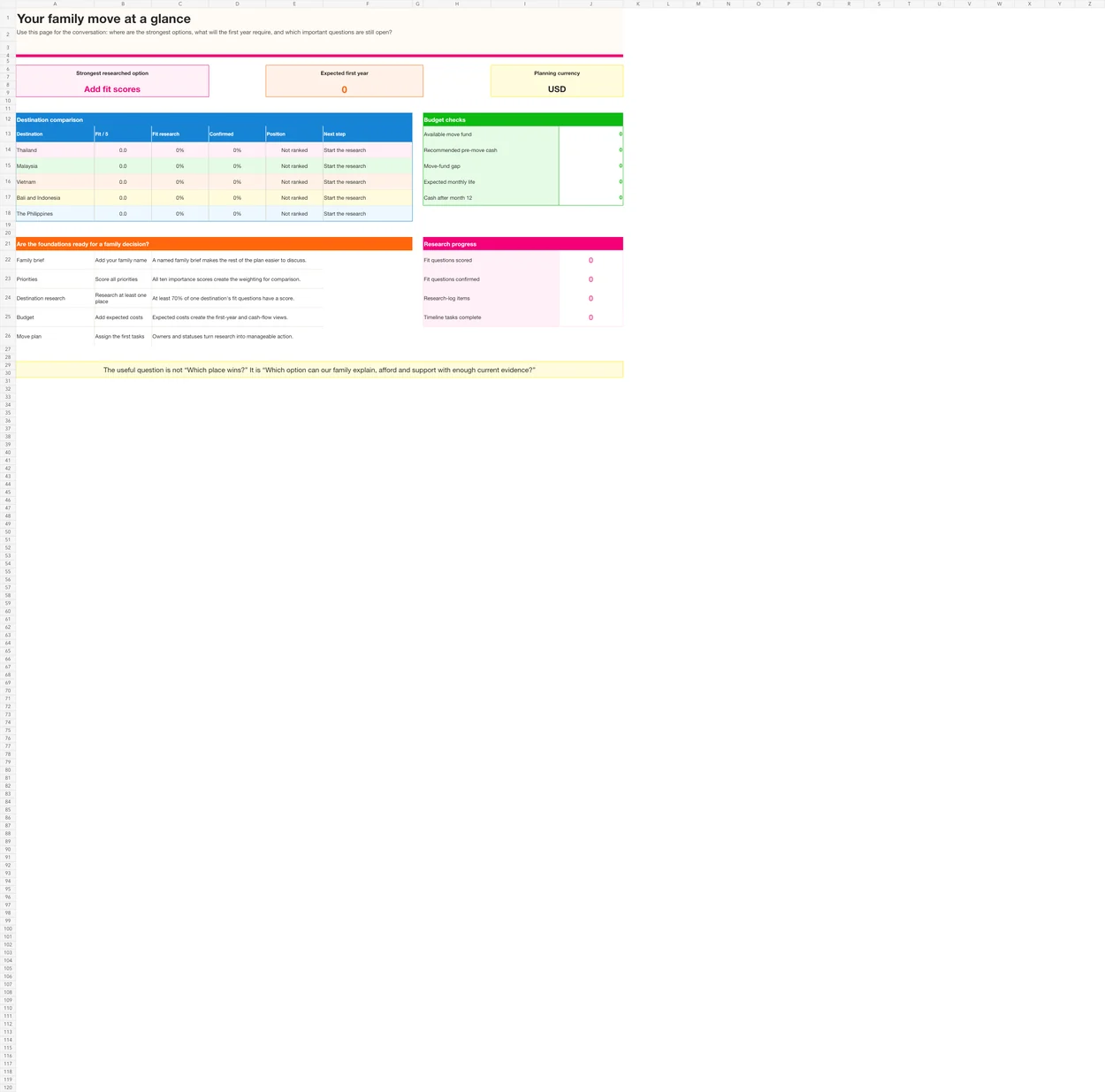
Use the Family Move Planner to carry your shortlist into a sourced destination comparison, realistic first-year budget and practical move timeline.
£39one-time digital purchase
Common questions
Questions about moving to Southeast Asia
Which Southeast Asian country is best for families?
Malaysia is our highest-graded all-rounder, while Thailand has the widest established choice of schools and healthcare. The best answer changes with visa eligibility, school needs, health, budget and each adult's work. Use the grade to narrow your options, not as a final verdict.
What is the cheapest country for a family of four?
The Philippines has the lowest starting point in our comparison, including a lower-cost international-school example, followed by Thailand, Malaysia and Vietnam. Premium schools and city housing can change the picture: a high-end Manila household may spend more than a cost-conscious Malaysian one.
Where is English easiest for children and parents?
English is most widely usable in Malaysia and the Philippines. It is also common in international schools, private hospitals and tourist/expat areas across the region, but language friction rises outside those settings—especially in Vietnam and less international parts of Thailand and Indonesia.
Can we move while working remotely for an overseas company?
Possibly, but an overseas employer and laptop do not settle immigration, tax or employment compliance. Thailand's DTV, Malaysia's DE Rantau and Indonesia's listed E33G category address some remote workers, each with different limits. Vietnam and the Philippines require particularly careful route analysis.
Do children need a separate student visa?
Often. Thailand's current DTV guidance specifically says a child whose main purpose is study should use an education route. Elsewhere a school, work or family sponsor may support the child's status. Never assume a parent's visa automatically covers school attendance or vice versa.
Which country has the best healthcare?
Thailand and Malaysia have the widest established choice of private care in this group, especially in Bangkok, Kuala Lumpur and Penang. Major cities in Vietnam and the Philippines have capable private facilities; families in Bali and more remote island locations need a clearer medical-transfer plan. Public or reciprocal healthcare rights depend on the country you are leaving, so check them separately.
Could we still pay tax in the country we leave?
Possibly. Departure-country residence, domicile or citizenship rules may continue to matter, while the destination applies its own residence and income-source rules. Tax treaties can provide relief but do not automatically remove filing duties. Get advice for the move year before transferring income or beginning remote work.
How long should we visit before choosing?
A useful research trip includes ordinary school mornings, a healthcare visit, supermarket and transport routines, and the least flattering local season where possible. Two to four weeks can reveal poor matches, but it cannot replace written confirmation of visas, school places and tax advice.
Should we choose a country, city or school first?
Start with suitable visa routes and any essential health or education needs, then compare cities and schools together. Finally choose a home with manageable journeys to school, healthcare and work. Choosing only by lifestyle can leave you with an exhausting commute or unaffordable school bill.