
🇹🇭 Household goods · customs before freight
Shipping belongings to Thailand
A move to Thailand can qualify for household-effects relief, but the timing, importer and contents need to fit the official rules. Decide what deserves freight space first, then make the bill of lading, visa evidence and inventory tell the same story.
Last verified 12 September 2026
The short answer
Can families ship used household goods to Thailand?
Thai Customs says used household effects needed for a normal home may receive duty and tax relief when a person genuinely changes residence and meets the conditions. Goods normally need to arrive no more than one month before or six months after the importer, and the importer must have owned, possessed and used them before the move.
Customs relief in plain English
Thailand's relief depends on a real change of residence
A long visit and a household move are not the same customs event. Confirm the named importer's eligibility and documents before the shipment leaves its origin country.
Furniture, appliances, kitchenware and similar goods normally needed to equip a self-contained home.
Commercial goods and unusual multiples can fall outside the concession; Thai guidance sets particular limits for duplicate electrical appliances.
Non-Thai residents normally need the applicable immigration, work or official evidence described by Customs.
Normally no earlier than one month before and no later than six months after the importer arrives.
Get written confirmation before loading. Customs decides eligibility at import, and another regulator may control particular goods. Ask the destination agent to cite the current rule for the named importer, goods, port and arrival date.
The country-specific checkpoint
Put the six-month customs window on the move calendar
The shipment, visa evidence and home plan have to meet at the right time. Do not let a freight schedule decide the customs strategy by accident.
Confirm the importer
Ask the destination agent which passport, visa, work-permit or immigration evidence supports this exact household move.
Earliest normal arrival
If goods arrive early, make sure the importer and agent can clear them and that storage charges are understood.
Keep entry evidence
Retain the passport entry record and make names match the bill of lading, packing list and customs papers.
Latest normal arrival
Do not treat the outer date as a target; sailing changes and document queries need spare time.
Build the clearance file
Make the person, shipment and inventory agree
Exact requirements vary by status and port. Use this as a preparation structure, then replace assumptions with the current list from customs or the licensed destination broker.
Identity and status
- Passport and relevant entry record
- Visa, work permit or other qualifying residence evidence
- Employer, immigration or relationship evidence where the route requires it
Shipment record
- Bill of lading or air waybill in the agreed consignee name
- Numbered packing list with used condition, quantity and defensible values
- Passport name and destination details consistent across every document
Evidence file
- Photos and ownership evidence for higher-value goods
- Insurance schedule and pre-packing condition record
- Permits or regulator approval for any controlled item
Restricted, regulated or separate
Check the exact item—not only the carton label
This is a risk screen, not an exhaustive prohibited-goods list. Product rules change and often sit with health, agriculture, communications, security or trade authorities rather than customs alone.
| Goods | Likely position | What to do before shipping |
|---|---|---|
| Vehicles and vehicle parts | Not included in ordinary household-effects relief | Do not load without specialist written import and tax advice. |
| Firearms, ammunition and weapons | Restricted and potentially prohibited without authority | Exclude unless every Thai permit and carrier requirement is confirmed before shipment. |
| Food, plants, animals and medicine | May involve health, agriculture or other regulators | Check the exact product, quantity and permit route; do not hide it in a mixed carton. |
| Alcohol, tobacco, new multiples and commercial goods | Tax, quantity or commercial-use issues | Separate, declare accurately and expect relief not to cover ordinary commercial stock. |
Sell · store · fly · ship
Give every possession a deliberate route
Judge replacement difficulty, suitability for the likely home and complete landed cost. Sentimental value is valid—but it should be named, not hidden inside a financial calculation.
Sell or donate
Best for: Bulky, low-value or climate-wrong items
Flat-pack furniture, old mattresses, large heaters and items unlikely to fit the next home.
Compare realistic resale value with avoided packing, freight, destination handling and disposal costs.Store
Best for: Meaningful items with a genuine return plan
Archives, heirlooms and furniture intended for a known future home.
Set a review date and compare several years of storage, insurance and eventual collection with the item's value.Fly with you
Best for: The first four to six weeks
Documents, prescribed medicine, school and work kit, chargers, a familiar child item and adaptable clothing.
Keep irreplaceable documents and essential medicine in hand luggage; check airline battery and liquid rules.Ship
Best for: Used possessions that are difficult or costly to replace
Well-used household goods that fit the likely home and can be described and valued clearly.
Load only after the importer, customs route, delivery address and complete destination-charge schedule are confirmed.Choose the shipping method
Buy the route your family needs—not empty container space
Transit times are estimates. Compare collection-to-delivery ranges, all handling stages and what happens if the family or the shipment arrives first.
| Method | Timing pattern | Best for | Watch |
|---|---|---|---|
| Extra checked baggage | Travels with the family | A compact landing kit | Airline weight, dimensions, batteries, liquids and customs declaration |
| Courier or air freight | Usually faster, but not guaranteed | A small, urgent and clearly documented load | Chargeable weight, customs brokerage and restricted-item rules |
| Shared sea freight | Flexible and consolidation-dependent | A modest volume without a full container | Waiting for consolidation, handling at more stages and minimum charges |
| Full container | Scheduled sailing plus clearance | A genuinely large justified household move | Container size does not make low-value furniture worth shipping; demurrage and access matter |
A useful inventory
Write what is actually in each carton
“Household effects” is not enough for customs, insurance or a damage claim. Number every package and keep one master record that can be sorted by carton, room, item category and control status.
- Plain description, quantity and used or new condition
- Defensible customs value in the required currency and valuation basis
- Make, model and serial number for electronics and valuable equipment
- Permit status for food, medicine, plants, animal products, radios, drones or other controlled goods
- Dated photographs and ownership evidence for higher-value items
- Quantity
- 14 pieces
- Condition
- Used · 4 years
- Value
- Record agreed basis
- Control check
- No food or blades
The landed-cost quote
Price the parts that appear after the headline freight rate
Ask every bidder to mark each line included, excluded, estimated or payable directly. “Door-to-door” is useful only when the contract defines both doors and every handoff between them.
Port and terminal handling
Local handling, documentation, wharfage or terminal charges may sit outside the ocean or air-freight rate.
Which named destination charges are included, estimated or payable directly?Customs and inspection
Brokerage, scanning, unpacking, examination, duties, taxes and permits can be separate even when the quote says door-to-door.
Who pays if customs requests an inspection or revised declaration?Storage and delay
Free time can be short. Port storage, warehouse storage and container demurrage may accrue on different clocks.
How many free days apply, when does each clock start and what is the daily rate?Final delivery
Truck access, lifts, stairs, parking, island legs, unpacking and debris removal should be priced for the real address.
What access assumptions could trigger an extra charge?Delays, inspection and final delivery
Plan for the awkward week, not only the smooth sailing
Consolidation can blur the timetable
A shared container may wait for other loads. Ask for a realistic range and the plan if arrival moves outside your document or housing window.
Bangkok access is part of the quote
Condominium booking rules, truck access, lifts and restricted delivery hours can turn final delivery into an extra handling job.
Humidity changes packing needs
Ask how wrapping, ventilation and insurance deal with moisture, mould and long storage in a tropical climate.
Keep one month of family life outside the shipment
Hold documents, essential medicine, chargers, school and work kit, several climate-appropriate outfits and a few familiar children's items with the family. Keep enough accessible money for temporary replacement, delivery changes or a customs query.
Insurance and mover checks
Ask who is responsible at every handoff
People
Who is the named destination agent, customs broker and carrier? Who answers when a carton, document or delivery slot is missing?
Cover
Is cover all-risk or named-perils? Check valuation, excess, owner-packed goods, mould, pairs and sets, storage, notice deadlines and claim jurisdiction.
Price
Is volume measured or estimated? Which currency, exchange-rate rule, minimum charge, access assumption and surcharge can change the final bill?
Delay
What are the realistic routing range, free storage days, demurrage rates and responsibilities if customs or housing is not ready?
Continue the household plan
Connect the shipment to the home and first month
Bring the research together
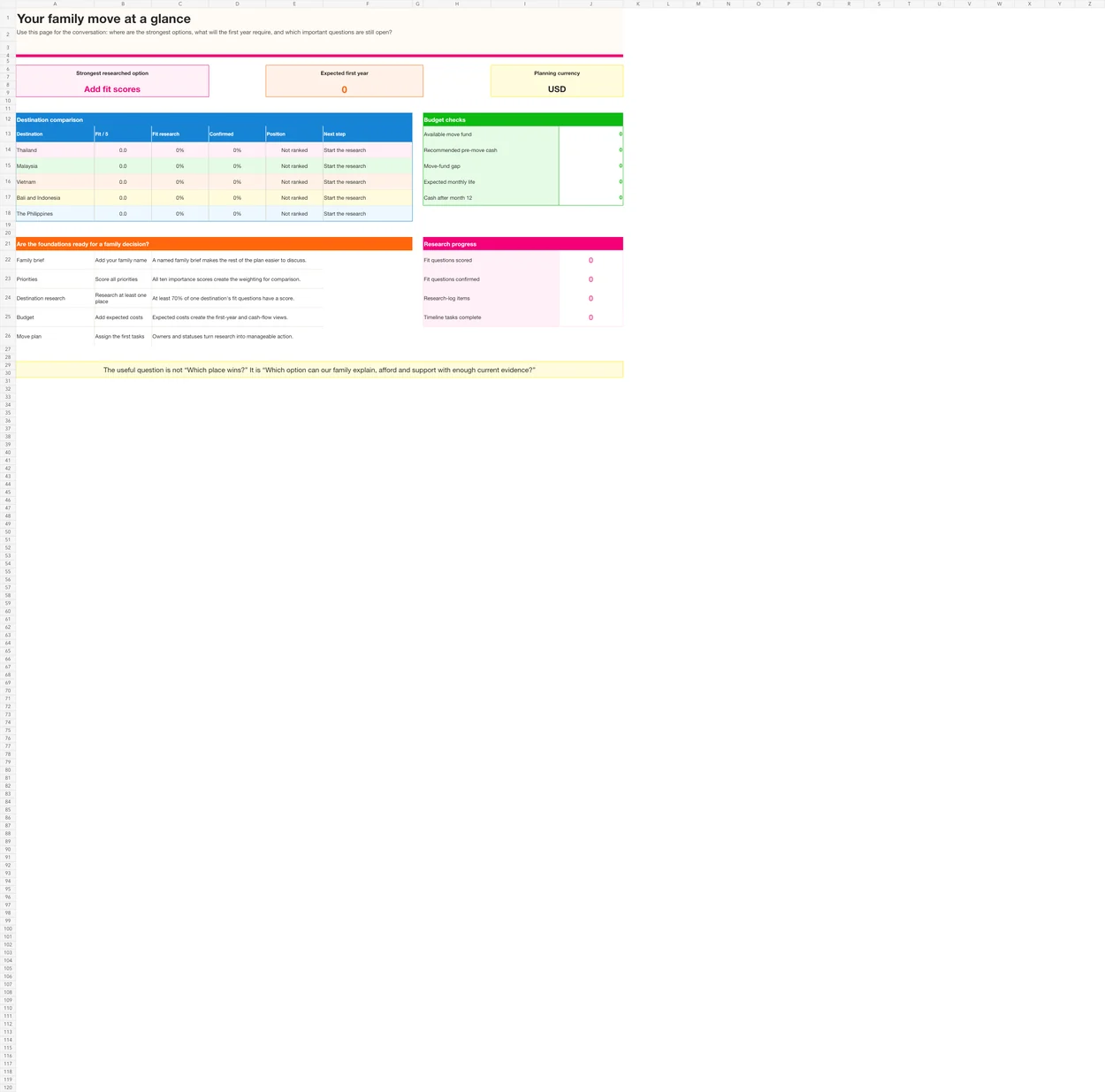
Ready to turn your research into a family move plan?
The Family Move Planner keeps your destination comparison, family priorities, budget, sources, questions and timeline in one organised system.
£39one-time digital purchase

Common questions
Questions about shipping belongings to Thailand
Is it worth shipping furniture to Thailand?
Often only when an item is genuinely useful, difficult to replace and likely to fit the next home. Compare its landed, insured cost with a realistic local replacement—not its original purchase price.
Does door-to-door mean every charge is included?
Not necessarily. Ask the mover to identify origin packing, export handling, linehaul, terminal charges, customs clearance, duty and tax, inspection, storage, demurrage, final access, unpacking and insurance as included, excluded, estimated or payable direct.
Should we use air freight or sea freight?
Air freight or extra baggage suits a small arrival layer needed quickly. Sea freight suits a justified larger volume with flexible timing. Compare the complete landed cost and plan for delay rather than relying on a best-case transit time.
Can customs open or inspect a household shipment?
Yes. Customs and other regulators may scan, open, examine, query or hold a shipment. An accurate inventory, matching documents and a budget for inspection and storage reduce—but do not remove—the risk.
How should we insure household goods?
Check whether the policy is all-risk or named-perils, the valuation basis, excess, owner-packed exclusions, mould and humidity treatment, pairs-and-sets rules, claim deadline and evidence needed. Photograph valuable items before packing.
Can the mover decide what is restricted?
Use the mover's operational experience, but verify controlled goods with the destination customs authority or relevant regulator. The named importer remains exposed if an inventory is incomplete or a permit is missing.
What should never go in the main shipment?
Keep passports, original status papers, essential medicine, valuables, irreplaceable records, daily work and school equipment and the family's first-weeks kit with you. Freight can be delayed, damaged or held.
When should we book storage at the destination?
Only after the mover explains port free time, customs timing and warehouse terms. Flexible warehouse storage can be useful while housing is uncertain, but port storage and demurrage are usually expensive ways to wait.