
🇹🇭 Family cover · hospitals · difficult-year costs
Health insurance in Thailand for expat families
Thailand has a large private-hospital market, but a familiar hospital name does not guarantee cashless care or make every policy suitable. Build the decision around the exact hospitals your family could use in Bangkok, Chiang Mai or Phuket, then test the policy's payment, transfer and renewal rules.
Last verified 12 September 2026
The short answer
What cover should a family consider?
A relocating family usually needs a funded route for everyday care, serious hospital treatment and any transfer that could be needed from its chosen city. Compare Thai-issued and international policies on the same hospitals and benefits. Employment-linked social security may help an eligible worker, but it should not be assumed to provide the private, family-wide cover you want.
Careful-use note: this comparison is reviewed quarterly and when a regulator publishes a material change. It explains research questions, not personal insurance advice or a policy recommendation.
Three different jobs
Compare the cover layers before comparing premiums
Start by deciding what you expect each layer to do. A statutory scheme, local private policy and international policy can all be useful without being interchangeable.
Option 1
Employment-linked care
- Most useful for
- Eligible employee's statutory route
- What it can add
- Can provide treatment through the assigned or registered system where employment and contribution rules are met.
- Do not assume
- Do not assume spouse or child cover, free choice of private hospital, overseas treatment or evacuation.
Option 2
Thai private policy
- Most useful for
- Domestic treatment
- What it can add
- May pair well with Thai private hospitals and baht-denominated family budgets.
- Do not assume
- Check hospital network, room limits, lifetime renewal, age limits, underwriting and treatment outside Thailand.
Option 3
International policy
- Most useful for
- Regional choice and portability
- What it can add
- Can include wider hospital access, treatment elsewhere in Asia and medical evacuation.
- Do not assume
- Higher premium does not remove exclusions, pre-authorisation, deductibles or the possibility of a deposit.
The destination changes the policy test
Match the policy to the Thailand your family will actually live in
Bangkok offers the greatest specialist depth. Families elsewhere should make the domestic-transfer wording as concrete as the local hospital network.
Bangkok
Specialist depth
List a routine hospital and a paediatric or adult specialist hospital that are realistic from home and school, not simply well known.
Chiang Mai
Domestic transfer
Ask which conditions could require Bangkok, who arranges the transfer and whether road or air transport is covered.
Phuket
Island access
Check traffic to the chosen emergency hospital and the full chain from stabilisation to airport and receiving facility.
Everywhere
Cashflow
Hospital direct billing can still depend on a guarantee letter, so keep a payment method and medical reserve available.
Inpatient, outpatient and direct billing
Cashless care still has four checks
Inpatient cover usually concerns admission or day-case treatment; outpatient cover usually concerns consultations, tests and treatment without admission. Neither label confirms that the hospital will bill the insurer directly.
- 1
Is the care covered?
Check the condition, treatment, territory, waiting period and benefit limit.
- 2
Can this hospital bill directly?
Confirm the exact branch, service and insurer or assistance-company agreement.
- 3
Has the insurer authorised it?
Planned treatment may need pre-authorisation and a guarantee of payment.
- 4
What must the family pay?
Settle the deductible, co-pay, deposit, room difference and excluded items.
A local example—not an endorsement
Bumrungrad's published process shows why a hospital appearing in a network is only the start: non-contracted outpatient care is self-paid, some procedures need pre-authorisation, and a patient can be asked to pay if the guarantee has not arrived. Ask the exact hospital branch to confirm the process for each family member and benefit.
Compare total annual exposure
Work out the premium and the costs the policy leaves with you
A low premium can create a high-cost year. Use the actual family deductible, co-pay and exclusions rather than comparing headline limits alone.
Ordinary year
Premium + self-funded appointments, medicines and routine dental/optical care.
One admission
Premium + deductible + co-pay + room difference + any deposit held while approval is processed.
Complex year
Everything above + excluded treatment + domestic transfer + travel and accommodation for the accompanying parent.
Use the family maximum, not a single-person example. Check whether deductibles and limits reset per person, condition, claim or policy year—and model a claim close to renewal.
Family wording worth reading slowly
The headline benefit rarely tells the whole story
Ask the same questions during quotation and after medical underwriting. A broker summary is helpful, but the final policy schedule and written insurer decision control the cover.
Children and therapy
Check paediatric consultations, congenital conditions, developmental assessments, speech or occupational therapy and child mental-health limits.
Maternity and newborns
Treat pregnancy, delivery and the baby's policy as three linked decisions. A waiting period can start before conception.
Existing conditions
Obtain written decisions for symptoms, repeat prescriptions, planned tests and previous treatment, even where a broker describes them as minor.
Renewal in later life
Check guaranteed-renewal wording, maximum entry and renewal ages, claims-based changes and what happens after a move away from Thailand.
Medical evacuation
Cover the whole journey, not just the flight
An evacuation benefit is useful only when the medical trigger, transport, receiving hospital and family arrangements fit the place you live.
Local capability
Bangkok may be the most suitable receiving city for many complex cases.
Possible transfer
Chiang Mai and Phuket families should confirm domestic ground or air transfer, airport handling and an accompanying parent.
Policy wording
Do not pay for vague evacuation wording. Ask who declares local care inadequate, where the insurer may send the patient and whether choosing another country becomes your cost.
Before paying a premium
Verify the insurer and the contract
Office of Insurance Commission (OIC)
For a Thai-issued policy or Thailand-based intermediary, check the insurer, broker or agent through the OIC's services and retain the legal entity named in the contract. If an international policy is issued elsewhere, identify that issuing entity and its home regulator instead of assuming Thai protection applies.
- Insurer and issuing legal entity
- Broker or agent licence
- Policy territory and governing law
- Complaint route and documents
Interactive research checklist · downloadable PDF
Keep every quote comparable
Use the checklist before contacting an insurer or broker, save your progress in this browser and download the one-page version for your family move folder.
Research from home
Family health-insurance research checklist
Use this guide to ask every insurer the same questions and compare their written answers before choosing a policy.
How to use it: read the section above first, then tick an item when you have captured the answer or evidence in your own move folder. The PDF is the offline quick-reference version.
1Describe the care your family may need
2Compare the written policy details
3Consider a difficult year
Continue the family health plan
Connect insurance to the care your family may need
Bring the research together
Ready to turn your research into a family move plan?
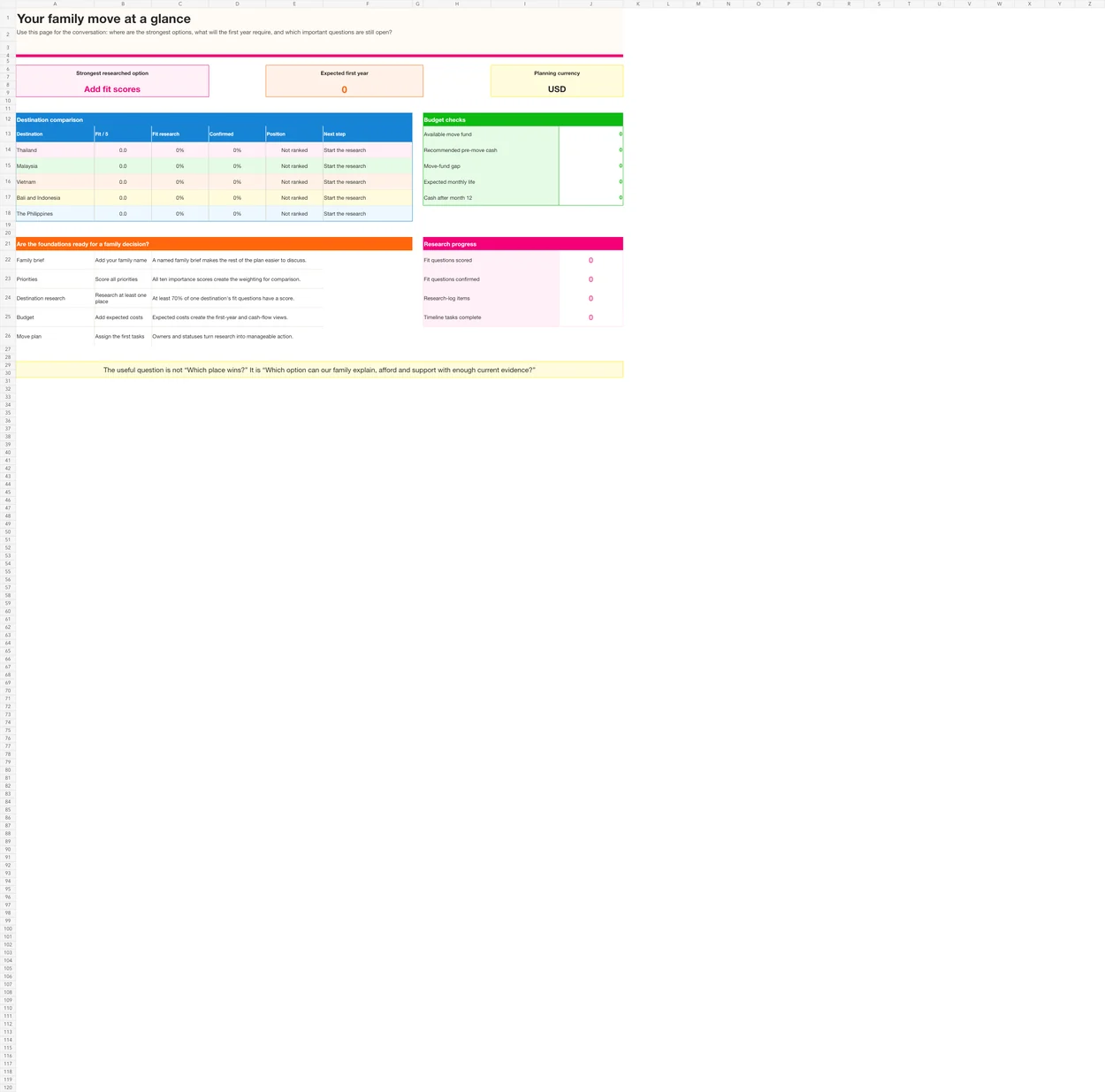
The Family Move Planner keeps your destination comparison, family priorities, budget, sources, questions and timeline in one organised system.
£39one-time digital purchase
Common questions
Questions about family health insurance in Thailand
Should a family choose local or international health insurance in Thailand?
Neither label is automatically better. Local cover may offer a practical domestic hospital network and lower premium, while international cover may add regional treatment, portability and medical evacuation. Compare the issuing insurer, exact territory, hospitals, benefit limits, underwriting and renewal terms rather than the product name.
Is inpatient-only insurance enough for a family?
It can be a sensible major-medical structure if the family can comfortably self-fund consultations, tests, medicines and deposits. Add the annual premium to realistic outpatient spending and the maximum deductible, co-pay and excluded care before deciding that inpatient-only cover is cheaper.
Does direct billing mean the hospital will not ask for money?
No. The exact hospital branch, treatment and insurer relationship must qualify, and planned care may need pre-authorisation. A deposit, deductible, co-pay, room upgrade or excluded item can still be payable. Keep an accessible medical reserve.
How do deductibles and co-pays work?
A deductible is the eligible amount paid before cover responds under the policy rule; a co-pay is a fixed or percentage share paid alongside the insurer. Check whether each applies per person, policy year, condition, visit or claim, and whether there is a family maximum.
Can pre-existing conditions be covered?
Sometimes. An insurer may accept a condition, charge more, limit it, exclude it, postpone a decision or decline the application. Disclose symptoms, medicines, investigations and pending referrals fully, then rely only on the final written underwriting terms.
What should maternity insurance include?
Check the waiting period before conception, normal delivery, complications, antenatal care, fertility treatment, newborn notification deadline, congenital conditions, neonatal intensive care and whether the baby receives cover without fresh underwriting. Maternity and newborn limits may be much lower than the headline annual limit.
What does medical evacuation cover actually pay for?
Wording varies. Check who decides that local care is inadequate, whether stabilisation and ground transport are included, the receiving destination, commercial-flight upgrades or air ambulance, an accompanying parent, return travel and what happens if the family prefers a different hospital.
How often should we review family health insurance?
Review it before each renewal and whenever the family moves, changes hospital, plans a pregnancy, receives a diagnosis or adds a child. Recheck insurer regulation, network participation, territorial limits, direct-billing arrangements, renewal terms and emergency contacts.
Does a Thai retirement or long-stay visa policy provide complete family health cover?
Not necessarily. Immigration compliance and useful medical cover are separate tests. Confirm the current visa rule with the issuing authority, then assess hospitals, benefits, exclusions, renewal and evacuation as a healthcare decision.
Is Bangkok cover enough if we live in Phuket or Chiang Mai?
Only if the policy also works where you live and pays for the transfer when necessary. Confirm the local emergency hospital, stabilisation costs, domestic transport, Bangkok receiving facility and parent travel in writing.