
🇻🇳 Family cover · hospitals · difficult-year costs
Health insurance in Vietnam for expat families
Vietnam's private and international-facing hospitals can make routine family care straightforward in major cities, but direct billing is contract-specific and specialist depth varies. Compare cover using named facilities in Ho Chi Minh City, Hanoi or Da Nang and a realistic plan for treatment elsewhere.
Last verified 12 September 2026
The short answer
What cover should a family consider?
Families should separate any employment-linked social health benefits from the private or international cover they expect to use. A local plan may suit domestic hospital care; international cover may add portability and regional evacuation. In either case, the hospital may request a deposit while a guarantee is processed.
Careful-use note: this comparison is reviewed quarterly and when a regulator publishes a material change. It explains research questions, not personal insurance advice or a policy recommendation.
Three different jobs
Compare the cover layers before comparing premiums
Start by deciding what you expect each layer to do. A statutory scheme, local private policy and international policy can all be useful without being interchangeable.
Option 1
Social health insurance
- Most useful for
- Eligible employment-linked benefits
- What it can add
- Can contribute within Vietnam's statutory system where enrolment and referral requirements are met.
- Do not assume
- It is not automatically the same as private-room, international-clinic, overseas-treatment or evacuation cover.
Option 2
Vietnamese private policy
- Most useful for
- Domestic private treatment
- What it can add
- May align with local billing and private-hospital networks in Vietnam.
- Do not assume
- Check named facilities, benefit schedules, territory, renewal, exclusions and whether the family can move the cover abroad.
Option 3
International policy
- Most useful for
- Regional treatment and continuity
- What it can add
- Can offer a broader territory and a route to care in another Asian medical centre.
- Do not assume
- Verify the issuing entity, lawful sales route, guarantee process and every country-of-residence restriction.
The destination changes the policy test
Plan for the gap between a clinic visit and complex care
A facility that works well for everyday paediatrics may not be the final destination for intensive or highly specialised treatment.
HCMC
Wider southern choice
Map a routine clinic, emergency hospital and specialist escalation route through actual insurer networks.
Hanoi
Public and private pathways
Check language, referral and payment arrangements rather than assuming every major hospital offers the same international access.
Da Nang
A smaller specialist market
Ask which conditions move to Hanoi, Ho Chi Minh City or another country and who coordinates the transfer.
All cities
Cashless is conditional
Direct billing normally requires a contracted insurer, documents and a valid guarantee of payment.
Inpatient, outpatient and direct billing
Cashless care still has four checks
Inpatient cover usually concerns admission or day-case treatment; outpatient cover usually concerns consultations, tests and treatment without admission. Neither label confirms that the hospital will bill the insurer directly.
- 1
Is the care covered?
Check the condition, treatment, territory, waiting period and benefit limit.
- 2
Can this hospital bill directly?
Confirm the exact branch, service and insurer or assistance-company agreement.
- 3
Has the insurer authorised it?
Planned treatment may need pre-authorisation and a guarantee of payment.
- 4
What must the family pay?
Settle the deductible, co-pay, deposit, room difference and excluded items.
A local example—not an endorsement
Vinmec's published process requires an insurer with a direct-billing agreement, a guarantee of payment, passport and insurance card, and a deposit based on estimated treatment. The hospital then confirms the covered scope and the patient pays anything outside it. Use that as a practical question list for any Vietnamese facility.
Compare total annual exposure
Work out the premium and the costs the policy leaves with you
A low premium can create a high-cost year. Use the actual family deductible, co-pay and exclusions rather than comparing headline limits alone.
Ordinary year
Premium + self-paid clinic visits, tests, medicines and services outside the eligible network.
One admission
Premium + deductible/co-pay + deposit + uncovered room, professional or supply charges.
Complex year
Everything above + transfer, overseas treatment, visas/travel for a parent and later follow-up.
Use the family maximum, not a single-person example. Check whether deductibles and limits reset per person, condition, claim or policy year—and model a claim close to renewal.
Family wording worth reading slowly
The headline benefit rarely tells the whole story
Ask the same questions during quotation and after medical underwriting. A broker summary is helpful, but the final policy schedule and written insurer decision control the cover.
Outpatient and diagnostics
Check consultations, laboratory work and imaging separately; a broad outpatient label can still contain visit, provider or test limits.
Maternity and newborns
Ask about the waiting period, maternity sub-limit, complications, neonatal care and the deadline for adding the baby.
Existing conditions
Translate or summarise diagnoses, symptoms, medicines and pending tests, then keep the insurer's decision in English where possible.
Chronic medicines
Drug cover may differ from consultations and tests. Check local availability, lawful prescriptions and annual or per-condition limits.
Medical evacuation
Cover the whole journey, not just the flight
An evacuation benefit is useful only when the medical trigger, transport, receiving hospital and family arrangements fit the place you live.
Local capability
Ho Chi Minh City and Hanoi offer the widest domestic specialist choice; Da Nang may use a domestic transfer first.
Possible transfer
For selected complex cases, a policy may consider Bangkok, Singapore or another suitable centre, subject to medical necessity and authorisation.
Policy wording
Ask whether domestic transfer and international evacuation are separate benefits, who selects the destination and whether the policy pays for a parent, return travel and follow-up care.
Before paying a premium
Verify the insurer and the contract
Vietnamese insurance authorities and the 2022 Insurance Business Law
Vietnam's 2022 law provides the current core framework for insurers, branches, intermediaries and policyholders. Confirm the legal entity issuing the contract, whether it is licensed for the route offered and which regulator and law govern complaints—especially for cross-border international cover.
- Legal name of the issuing insurer
- Vietnam-licensed or cross-border basis
- Local intermediary's authority
- Governing law and complaint route
Interactive research checklist · downloadable PDF
Keep every quote comparable
Use the checklist before contacting an insurer or broker, save your progress in this browser and download the one-page version for your family move folder.
Research from home
Family health-insurance research checklist
Use this guide to ask every insurer the same questions and compare their written answers before choosing a policy.
How to use it: read the section above first, then tick an item when you have captured the answer or evidence in your own move folder. The PDF is the offline quick-reference version.
1Describe the care your family may need
2Compare the written policy details
3Consider a difficult year
Continue the family health plan
Connect insurance to the care your family may need
Bring the research together
Ready to turn your research into a family move plan?
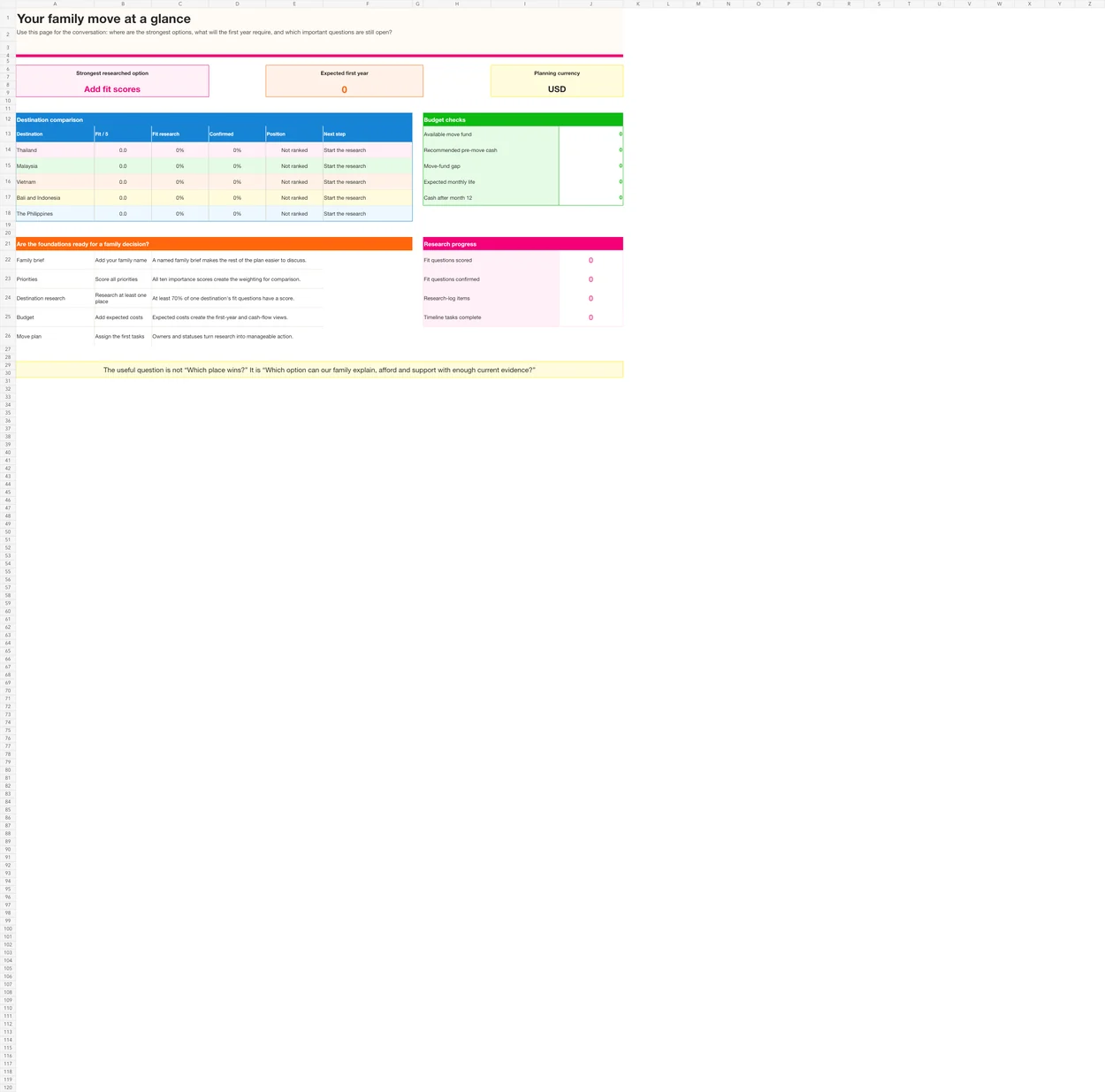
The Family Move Planner keeps your destination comparison, family priorities, budget, sources, questions and timeline in one organised system.
£39one-time digital purchase
Common questions
Questions about family health insurance in Vietnam
Should a family choose local or international health insurance in Vietnam?
Neither label is automatically better. Local cover may offer a practical domestic hospital network and lower premium, while international cover may add regional treatment, portability and medical evacuation. Compare the issuing insurer, exact territory, hospitals, benefit limits, underwriting and renewal terms rather than the product name.
Is inpatient-only insurance enough for a family?
It can be a sensible major-medical structure if the family can comfortably self-fund consultations, tests, medicines and deposits. Add the annual premium to realistic outpatient spending and the maximum deductible, co-pay and excluded care before deciding that inpatient-only cover is cheaper.
Does direct billing mean the hospital will not ask for money?
No. The exact hospital branch, treatment and insurer relationship must qualify, and planned care may need pre-authorisation. A deposit, deductible, co-pay, room upgrade or excluded item can still be payable. Keep an accessible medical reserve.
How do deductibles and co-pays work?
A deductible is the eligible amount paid before cover responds under the policy rule; a co-pay is a fixed or percentage share paid alongside the insurer. Check whether each applies per person, policy year, condition, visit or claim, and whether there is a family maximum.
Can pre-existing conditions be covered?
Sometimes. An insurer may accept a condition, charge more, limit it, exclude it, postpone a decision or decline the application. Disclose symptoms, medicines, investigations and pending referrals fully, then rely only on the final written underwriting terms.
What should maternity insurance include?
Check the waiting period before conception, normal delivery, complications, antenatal care, fertility treatment, newborn notification deadline, congenital conditions, neonatal intensive care and whether the baby receives cover without fresh underwriting. Maternity and newborn limits may be much lower than the headline annual limit.
What does medical evacuation cover actually pay for?
Wording varies. Check who decides that local care is inadequate, whether stabilisation and ground transport are included, the receiving destination, commercial-flight upgrades or air ambulance, an accompanying parent, return travel and what happens if the family prefers a different hospital.
How often should we review family health insurance?
Review it before each renewal and whenever the family moves, changes hospital, plans a pregnancy, receives a diagnosis or adds a child. Recheck insurer regulation, network participation, territorial limits, direct-billing arrangements, renewal terms and emergency contacts.
Will an international hospital in Vietnam always accept international insurance?
No. Direct billing depends on the exact insurer, third-party administrator, policy and hospital agreement. If a guarantee is delayed or declined, the family may need to pay a deposit or the full bill and seek reimbursement.
Does a Da Nang family need overseas evacuation cover?
It is worth comparing because the local specialist market is narrower than Hanoi or Ho Chi Minh City. Ask first whether the policy covers domestic transfer, then which conditions and destinations can trigger international evacuation.