
🇵🇭 Family cover · hospitals · difficult-year costs
Health insurance in the Philippines for expat families
The Philippines has three commonly confused layers: PhilHealth, private HMO arrangements and medical insurance. Families should understand what each layer pays, which facilities it can use and how treatment would work beyond Metro Manila or Cebu.
Last verified 12 September 2026
The short answer
What cover should a family consider?
Eligible foreign residents can register with PhilHealth and may also use an HMO, local medical insurance or international cover. These are not substitutes for one another: PhilHealth pays defined statutory benefits, an HMO arranges prepaid care through its network, and insurance responds under its policy. Compare the combined gaps and out-of-pocket cost.
Careful-use note: this comparison is reviewed quarterly and when a regulator publishes a material change. It explains research questions, not personal insurance advice or a policy recommendation.
Three different jobs
Compare the cover layers before comparing premiums
Start by deciding what you expect each layer to do. A statutory scheme, local private policy and international policy can all be useful without being interchangeable.
Option 1
PhilHealth
- Most useful for
- Eligible national-program benefits
- What it can add
- Can pay defined benefits at accredited providers when registration and qualifying contribution rules are met.
- Do not assume
- It does not necessarily settle the whole private-hospital bill or provide broad overseas treatment and evacuation.
Option 2
HMO or local cover
- Most useful for
- Network-based everyday and hospital care
- What it can add
- Can arrange specified prepaid services or insured benefits through named providers and authorisation routes.
- Do not assume
- HMO limits, network rules and letters of authorisation differ from an insurance policy; verify the exact product and regulator listing.
Option 3
International policy
- Most useful for
- Higher limits, portability and regional care
- What it can add
- Can provide a wider territory and medical evacuation from areas with less specialist depth.
- Do not assume
- Check the issuing insurer, Philippines provider network, direct-billing route and whether an HMO or PhilHealth must pay first.
The destination changes the policy test
Put the three payment layers in the right order
Ask what PhilHealth pays, what an HMO or insurer authorises and what the family must fund—then repeat the exercise for the actual city and hospital.
Layer 1
PhilHealth benefit
Confirm each family member's eligibility, active contribution status and the benefit available at an accredited provider.
Layer 2
HMO or local insurance
Check the provider network, benefit ceiling, letter of authorisation and treatment-specific exclusions.
Layer 3
International insurance
Map higher-cost care, treatment abroad and evacuation while checking coordination with the other layers.
Family share
Everything left over
Include deductibles, room differences, professional fees, deposits, uncovered medicines and travel for a transfer.
Inpatient, outpatient and direct billing
Cashless care still has four checks
Inpatient cover usually concerns admission or day-case treatment; outpatient cover usually concerns consultations, tests and treatment without admission. Neither label confirms that the hospital will bill the insurer directly.
- 1
Is the care covered?
Check the condition, treatment, territory, waiting period and benefit limit.
- 2
Can this hospital bill directly?
Confirm the exact branch, service and insurer or assistance-company agreement.
- 3
Has the insurer authorised it?
Planned treatment may need pre-authorisation and a guarantee of payment.
- 4
What must the family pay?
Settle the deductible, co-pay, deposit, room difference and excluded items.
A local example—not an endorsement
St Luke's published patient information says an HMO or insurance letter of authorisation or guarantee of payment is required on admission, while incomplete PhilHealth requirements can prevent a benefit deduction. Confirm the exact campus, product and emergency process rather than assuming one approval covers every charge.
Compare total annual exposure
Work out the premium and the costs the policy leaves with you
A low premium can create a high-cost year. Use the actual family deductible, co-pay and exclusions rather than comparing headline limits alone.
Ordinary year
PhilHealth contributions + HMO/insurance premium + co-pays, medicines and uncovered outpatient care.
One admission
Everything above + deductible + excess over benefit limits + room/professional-fee differences and deposits.
Complex year
Everything above + domestic or international transfer + accompanying-parent travel, lodging and follow-up.
Use the family maximum, not a single-person example. Check whether deductibles and limits reset per person, condition, claim or policy year—and model a claim close to renewal.
Family wording worth reading slowly
The headline benefit rarely tells the whole story
Ask the same questions during quotation and after medical underwriting. A broker summary is helpful, but the final policy schedule and written insurer decision control the cover.
HMO benefit ceiling
A broad provider network can still sit behind a relatively low annual, illness or procedure limit. Compare the amount, not only the logos.
Maternity and newborns
Compare PhilHealth eligibility, HMO maternity rules and private-policy waiting periods separately, including neonatal and congenital care.
Pre-existing conditions
PhilHealth, HMOs and insurance can apply different rules. Get a written answer from each relevant layer for the same medical history.
Care outside the main hubs
A network that looks broad nationally may offer less paediatric or specialist depth near the family's island or province.
Medical evacuation
Cover the whole journey, not just the flight
An evacuation benefit is useful only when the medical trigger, transport, receiving hospital and family arrangements fit the place you live.
Local capability
Metro Manila has the widest specialist depth; Cebu is an important regional hub for the central Philippines.
Possible transfer
Families elsewhere should plan stabilisation, domestic transfer and the possibility of regional treatment outside the country.
Policy wording
Check whether sea, road, commercial air or air-ambulance transfer is covered, who chooses Manila/Cebu/overseas care and whether weather disruption, parent travel and return are included.
Before paying a premium
Verify the insurer and the contract
Philippine Insurance Commission and PhilHealth
The Insurance Commission publishes current directories for authorised insurers, HMOs and intermediaries; PhilHealth separately manages National Health Insurance Program membership and benefits. Verify the precise organisation and product in the relevant current directory instead of relying on a salesperson's description.
- Authorised insurer or HMO
- Licensed broker or intermediary
- PhilHealth membership and contribution status
- Complaint and claims route for each layer
Interactive research checklist · downloadable PDF
Keep every quote comparable
Use the checklist before contacting an insurer or broker, save your progress in this browser and download the one-page version for your family move folder.
Research from home
Family health-insurance research checklist
Use this guide to ask every insurer the same questions and compare their written answers before choosing a policy.
How to use it: read the section above first, then tick an item when you have captured the answer or evidence in your own move folder. The PDF is the offline quick-reference version.
1Describe the care your family may need
2Compare the written policy details
3Consider a difficult year
Continue the family health plan
Connect insurance to the care your family may need
Bring the research together
Ready to turn your research into a family move plan?
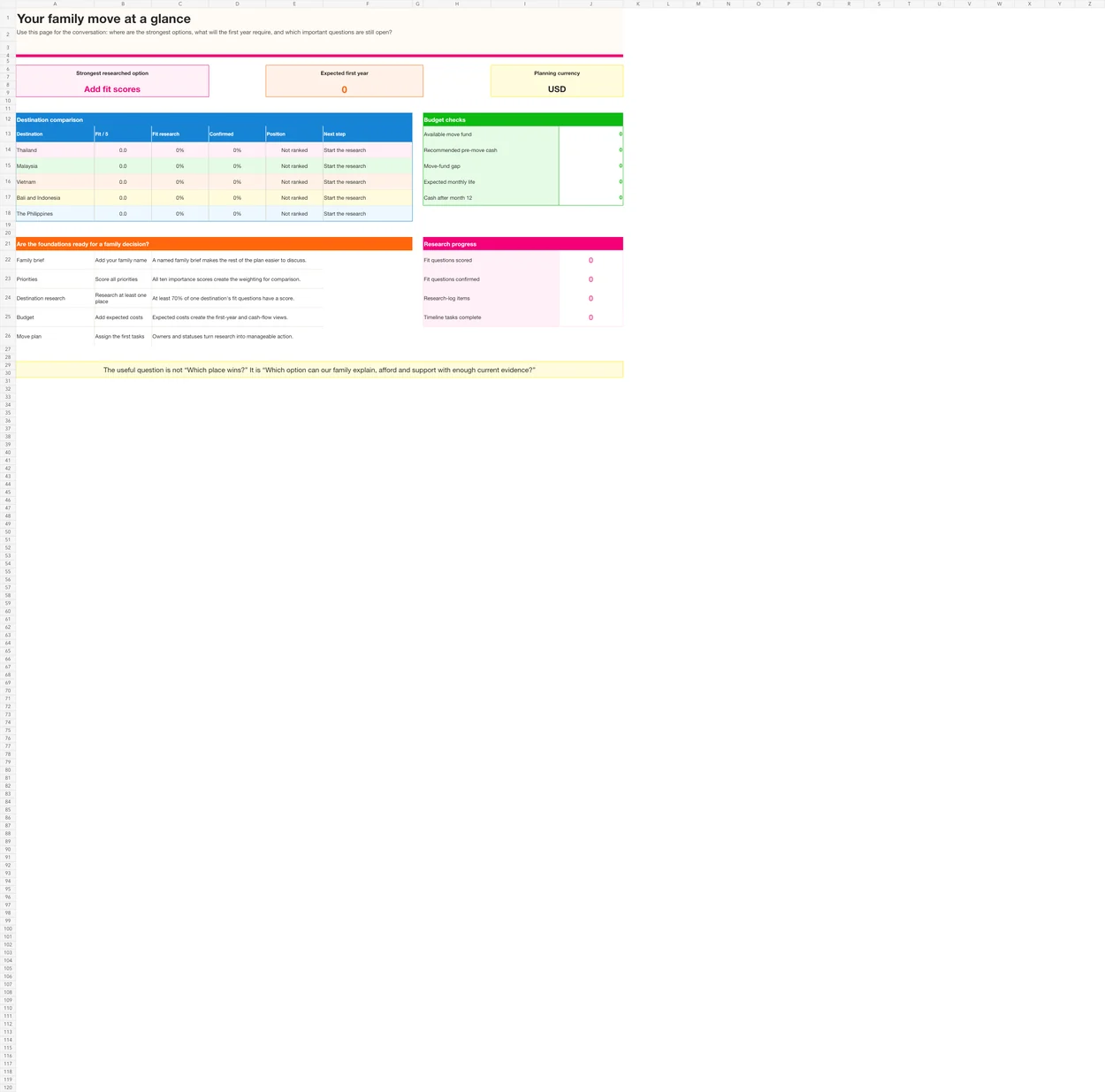
The Family Move Planner keeps your destination comparison, family priorities, budget, sources, questions and timeline in one organised system.
£39one-time digital purchase
Common questions
Questions about family health insurance in the Philippines
Should a family choose local or international health insurance in the Philippines?
Neither label is automatically better. Local cover may offer a practical domestic hospital network and lower premium, while international cover may add regional treatment, portability and medical evacuation. Compare the issuing insurer, exact territory, hospitals, benefit limits, underwriting and renewal terms rather than the product name.
Is inpatient-only insurance enough for a family?
It can be a sensible major-medical structure if the family can comfortably self-fund consultations, tests, medicines and deposits. Add the annual premium to realistic outpatient spending and the maximum deductible, co-pay and excluded care before deciding that inpatient-only cover is cheaper.
Does direct billing mean the hospital will not ask for money?
No. The exact hospital branch, treatment and insurer relationship must qualify, and planned care may need pre-authorisation. A deposit, deductible, co-pay, room upgrade or excluded item can still be payable. Keep an accessible medical reserve.
How do deductibles and co-pays work?
A deductible is the eligible amount paid before cover responds under the policy rule; a co-pay is a fixed or percentage share paid alongside the insurer. Check whether each applies per person, policy year, condition, visit or claim, and whether there is a family maximum.
Can pre-existing conditions be covered?
Sometimes. An insurer may accept a condition, charge more, limit it, exclude it, postpone a decision or decline the application. Disclose symptoms, medicines, investigations and pending referrals fully, then rely only on the final written underwriting terms.
What should maternity insurance include?
Check the waiting period before conception, normal delivery, complications, antenatal care, fertility treatment, newborn notification deadline, congenital conditions, neonatal intensive care and whether the baby receives cover without fresh underwriting. Maternity and newborn limits may be much lower than the headline annual limit.
What does medical evacuation cover actually pay for?
Wording varies. Check who decides that local care is inadequate, whether stabilisation and ground transport are included, the receiving destination, commercial-flight upgrades or air ambulance, an accompanying parent, return travel and what happens if the family prefers a different hospital.
How often should we review family health insurance?
Review it before each renewal and whenever the family moves, changes hospital, plans a pregnancy, receives a diagnosis or adds a child. Recheck insurer regulation, network participation, territorial limits, direct-billing arrangements, renewal terms and emergency contacts.
Can foreign residents join PhilHealth?
PhilHealth publishes membership routes for foreign citizens with qualifying residence or work documents. Confirm each person's current category, documents, contributions and status directly; a foreign spouse should not assume they are automatically covered as a Filipino spouse's dependent.
Is an HMO the same as health insurance in the Philippines?
No. An HMO arranges pre-agreed healthcare services for a fixed prepaid fee through its rules and network; insurance pays eligible losses under an insurance contract. The Insurance Commission supervises both sectors, but benefits, limits and claim mechanisms remain different.
Does PhilHealth pay the whole private-hospital bill?
Do not assume it does. PhilHealth pays benefits according to its current packages and eligibility rules; the patient remains responsible for charges outside the benefit. Ask the hospital for a written estimate showing PhilHealth, HMO/insurer and patient shares.